The physics of climate change: response
How does the physics of radiation - emission, absorption, and scattering - and the thermodynamics of water and air shape the planet's response to human activities?
We're broadly interested in how and why the climate system responds to perturbations including changes in greenhouse gas and aerosol concentrations. We've learned, for example, that the cooling of the stratosphere in response to increasing carbon dioxide concentrations is caused by the spectroscopic details of the most absorbing part of the strongest absorption band, with the size of the cooling set by how much ozone and water vapor also radiate from the stratosphere
- Cohen, S., R. Pincus, and L. M. Polvani 2026: Stratospheric cooling and amplification of radiative forcing with rising carbon dioxide. Nature Geosci., doi:10.1038/s41561-026-01965-8
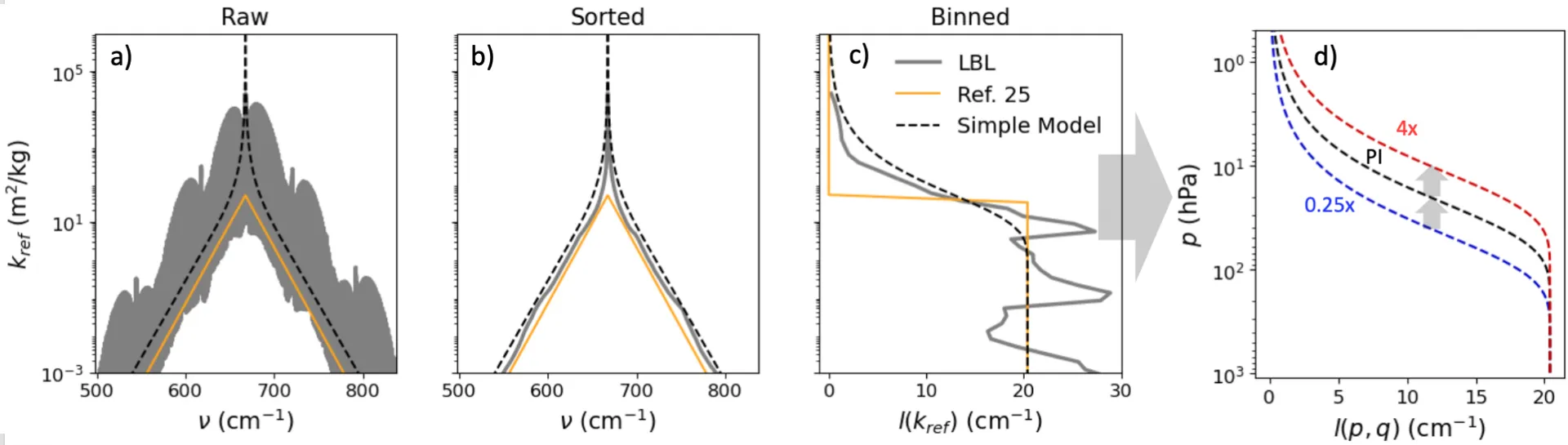
We've also shown how the increase in rainfall with surface temperature is controlled by the spectroscopic and thermodynamic properties of water vapor.
- Cohen, S. and R. Pincus, 2025: A spectroscopic theory for how mean rainfall changes with surface temperature. Sci. Adv., 11, eadv6191. doi:10.1126/sciadv.adv6191
A recent theme has been trying to understand how uncertainty about the water vapor continuum - weak absorption whose source and precise strength are still debated - impacts estimates of climate change.
- Mlawer, E. J., J. Mascio, D. D. Turner, V. Payne, C. Flynn, and R. Pincus, 2024. A more transparent water vapor window. J. Geophys. Res. Atmos. 129, e2024JD041366 doi:10.1029/2024JD041366 (with collaborators at AER)
- Roemer, F. E., S. A. Buehler, L. Kluft, and R. Pincus, 2023. Effect of uncertainty in water vapor continuum absorption on radiative forcing, longwave feedback, and climate sensitivity, J. Adv. Model. Earth Syst., 16, e2023MS004157, doi:10.1029/2023MS004157 (with collaborators at the University of Hamburg, Germany)